Decoy Drone Technology

통합 검색
통합 검색
Software
Moving beyond basic airframe hardware, InAIr has secured advanced capabilities in designing and developing specialized decoy platforms integrated with Active DRFM (Digital Radio Frequency Memory) technology.
By integrating active DRFM algorithms that capture, modulate, and retransmit radar signals, we provide sophisticated electronic warfare capabilities.
This allows us to deceive enemy radars by creating false targets or amplifying a drone’s radar signature to mimic larger, high-value assets.
By amplifying the Radar Cross Section (RCS), InAIr’s technology generates radar signatures identical to manned aircraft or high-value assets, perfectly deceiving enemy air defense networks.
This strategic deception draws enemy fire toward decoys, maximizing the survival probability of friendly assets.
By inducing chaos within hostile air defense systems, we drastically enhance the overall mission success rate.
1. DRFM-Based Decoy Technology
Active Electronic Countermeasure technology leveraging DRFM to capture, modulate, and retransmit radar signals for sophisticated tactical deception.
2. Luneburg Lens-Based Decoy Technology
Passive decoy technology utilizing integrated Luneburg lenses to physically amplify radar reflections, effectively mimicking the signatures of larger tactical assets.
Decoy Drone Technology
What is Decoy Drone Technology?
The Core of Advanced Deception Tactics : Mimicking Friendly Assets to Outsmart Enemy Air Defenses.
Typically, drones are difficult to detect due to their small size. However, drones equipped with this technology utilize specialized devices or electromagnetic signal amplification to project a presence as large as an actual fighter jet. In essence, it creates a "radar illusion," making a small drone appear on radar screens as a massive strike formation or a high-value asset.
The core value of this technology lies in maximizing battlefield survivability. By inducing the enemy to misidentify decoys as real threats and exhaust expensive anti-aircraft missiles, it drains their defense resources. Meanwhile, friendly forces secure the critical "Golden Time" to strike targets safely or infiltrate covertly.
Ultimately, the decoy drone serves as both a high-efficiency tactical bait and a protective shield, achieving a decisive advantage in modern warfare at a minimal cost.

The Core of Battlefield Transformation : InAIr’s Decoy Technology
❶ DRFM-Based Decoy Technology
❷ Luneburg Lens-Based Decoy Technology
InAIr possesses unrivaled core technologies in "Survivability and Deception," the decisive factors of victory in modern warfare.
We move beyond simple stealth to provide sophisticated tactical solutions that reshape the battlefield’s radar landscape in favor of friendly forces.
InAIr is uniquely equipped with both Active Deception—leveraging DRFM (Digital Radio Frequency Memory) to replicate and amplify electronic signals for false target generation—and Passive Deception—utilizing Luneburg Lenses to physically maximize radar reflections and mimic the signatures of actual fighter jets.
This hybrid capability, encompassing both active and passive methods, serves as a powerful shield that paralyzes enemy air defenses while protecting high-value friendly assets. By unifying software intelligence with hardware precision, InAIr’s decoy solutions guarantee overwhelming survivability in any environment, presenting a new paradigm for modern combat.
1. DRFM-Based Decoy Technology

InAIr DFRM
Frequency Range : CNFIDENTIAL
Instantaneous Bandwidth : CNFIDENTIAL
Range Deception : RGPO / MRGPO
Velocity Deception : VGPO / MVGPO
2. Luneburg Lens-Based Decoy Technology
What is a Luneburg Lens?
The Luneburg Lens, proposed by Rudolf Luneburg in 1944, is a spherical gradient-index (GRIN) lens characterized by a dielectric constant ($\epsilon_r$) that varies progressively from the surface to the center.
This unique structural property enables the lens to exhibit exceptional radar backscattering performance, reflecting incident electromagnetic waves (radar signals) precisely back toward their source. By mimicking the Radar Cross Section (RCS) of a full-sized fighter jet, it demonstrates outstanding effectiveness in confusing and neutralizing enemy air defense networks.
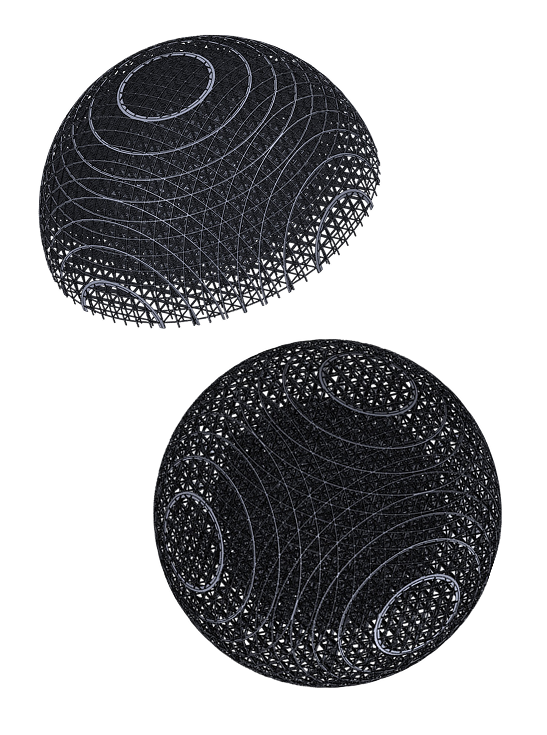
The Luneburg Lens has long been a strategic asset heavily dependent on foreign technology.
InAIr has successfully localized this core technology through proprietary R&D, securing technological sovereignty for the national drone industry.
Moving beyond simple replication, InAIr’s localized solution maximizes radar reflection efficiency through precise dielectric design and advanced process control. This allows even ultra-small drones to physically disguise themselves as massive fighter jets or high-value assets with flawless precision.
By localizing the entire process—from design to mass production—InAIr has eliminated risks associated with foreign technology dependence while providing peak tactical advantages at an optimized cost. Redefining standards in the global defense market, InAIr’s solutions stand as the most reliable passive deception power, ensuring the survivability of friendly forces in any extreme battlefield.